I have written the same 40-line Node script to debug a Postgres LISTEN
channel at least six times. You know the one:
const { Client } = require("pg");
const c = new Client({ connectionString: process.env.DB });
await c.connect();
await c.query("LISTEN order_events");
c.on("notification", (m) => console.log(new Date(), m.channel, m.payload));
console.log("listening...");
Save it as listen.js, node listen.js, stare at the terminal, trigger the
thing you are debugging, and pray the connection does not drop before the
event arrives — because if it does, you scroll back up, Ctrl+C, re-run, and
now the event has already happened and nobody is listening.
I rewrote this script on at least four different laptops. On two of them, I rewrote it twice because I forgot where I put it. At some point you have to stop.
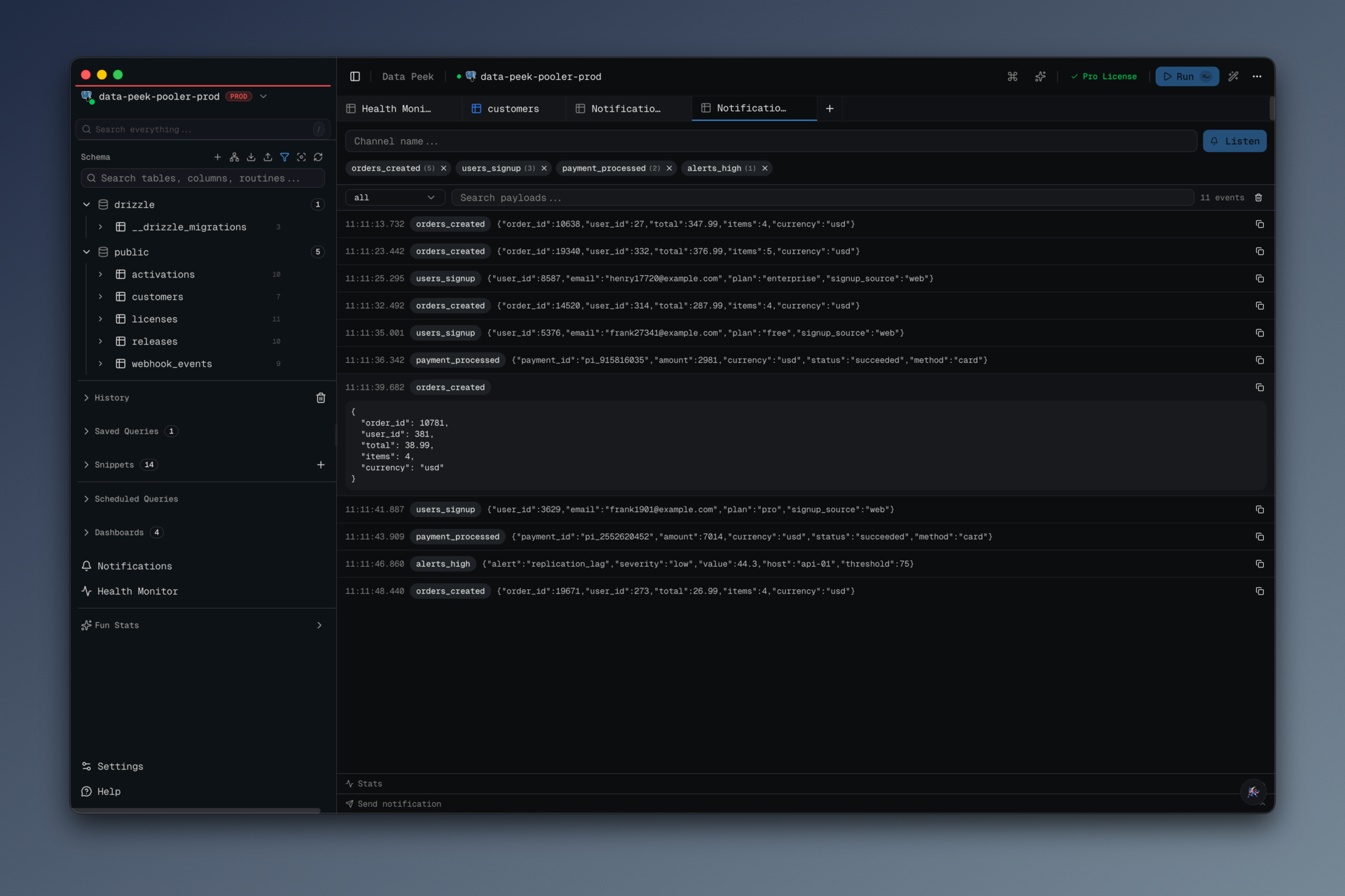
The Postgres LISTEN/NOTIFY panel in data-peek is the version I wish I had had the first time.
#What it does
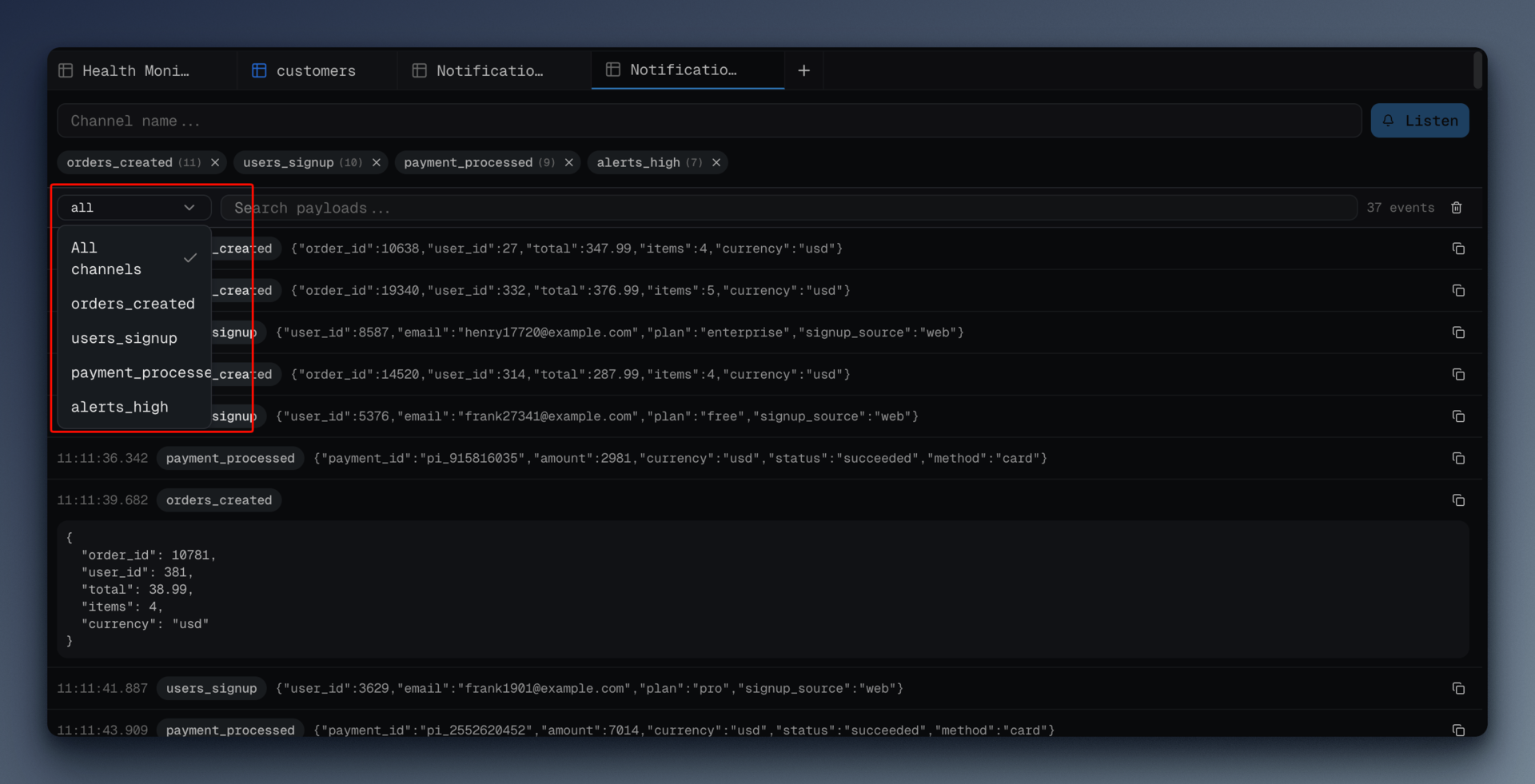
- Subscribe to one or many channels on a connection with a single input.
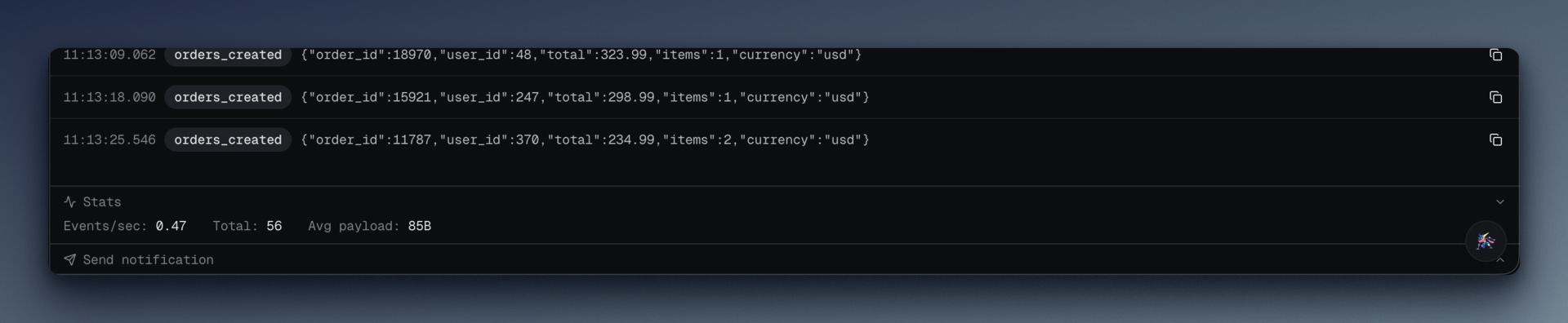
- See every event that arrives, live, with timestamp, channel, and payload.
- Keep the last 10,000 events per connection in a local SQLite database, so if you walk away and come back an hour later, the history is still there.
- Survive a dropped connection. If the Postgres server restarts, or your laptop's WiFi blips, the listener reconnects with exponential backoff and re-subscribes to everything you had open.
NOTIFYback with a "Send" button, so you can smoke-test your own channel without leaving the app.
The whole thing is one pg.Client per connection held open in the Electron
main process. The renderer just sends subscribe/unsubscribe IPC messages and
receives events through a webContents channel.
#The reconnect loop
If you have written a long-lived pg listener before, you know the three
things that go wrong: the client drops, the tunnel dies, or your backoff is
too aggressive and you hammer a recovering server. Here is the relevant slice
from src/main/pg-notification-listener.ts:
const MAX_BACKOFF_MS = 30_000;
const MAX_EVENTS_PER_CONNECTION = 10000;

function scheduleReconnect(connectionId, config, channels, backoffMs) {
  const entry = listeners.get(connectionId);
  if (entry?.destroyed) return;

  const nextBackoff = Math.min(backoffMs * 2, MAX_BACKOFF_MS);

  const timer = setTimeout(() => {
    const current = listeners.get(connectionId);
    if (current?.destroyed) return;
    connectListener(connectionId, config, channels, nextBackoff);
  }, backoffMs);

  if (entry) entry.reconnectTimer = timer;
}
The base delay is 1000ms, we double on every failure, and we cap at 30 seconds. That cap matters more than you think — without it, after enough failures you end up with a listener that tries once an hour and you swear the panel "doesn't work anymore" when actually it just happens to be in a two-hour retry gap.
The same reconnect-with-backoff discipline shows up elsewhere in the app — the connection health monitor applies it to every connection, not just the notification listener.
The destroyed flag is the quiet hero. Every ListenerEntry has one:
interface ListenerEntry {
  client: Client;
  tunnelSession: TunnelSession | null;
  channels: Set<string>;
  connectedSince: number;
  reconnectTimer?: ReturnType<typeof setTimeout>;
  destroyed: boolean;
}
When the user closes the panel or switches connections, I set destroyed = true before calling client.end(). That matters because client.end()
triggers the 'end' event, which would otherwise kick off a reconnect
attempt three seconds later — a stubborn zombie listener that refuses to die.
The check if (entry.destroyed) return at the top of the reconnect branch
is what makes the cleanup actually clean up.
Both the 'error' and 'end' handlers route through the same reconnect
path:
client.on("error", (err) => {
  if (entry.destroyed) return;
  log.error(`pg notification client error for ${connectionId}:`, err);
  scheduleReconnect(connectionId, config, entry.channels, backoffMs);
});

client.on("end", () => {
  if (entry.destroyed) return;
  log.warn(
    `pg notification client disconnected for ${connectionId}, reconnecting...`,
  );
  scheduleReconnect(connectionId, config, entry.channels, backoffMs);
});
Note that I re-subscribe to entry.channels, not to the original channels
parameter. If the user added a channel since the initial connect, this makes
sure the reconnect picks up the new set. I did not have this right the first
time; I lost a channel on every reconnect until I noticed.
#Event history, in SQLite
Events are not just forwarded to the renderer — they also go into a local SQLite database in the user's Electron data dir:
sqliteDb.exec(`
  CREATE TABLE IF NOT EXISTS pg_notification_events (
    id TEXT PRIMARY KEY,
    connection_id TEXT NOT NULL,
    channel TEXT NOT NULL,
    payload TEXT NOT NULL,
    received_at INTEGER NOT NULL
  )
`);

sqliteDb.exec(`
  CREATE INDEX IF NOT EXISTS idx_pne_connection_received
  ON pg_notification_events (connection_id, received_at DESC)
`);
That composite index on (connection_id, received_at DESC) is what keeps the
history query fast as the table fills toward 10,000 rows. If you are ever
unsure an index like this is actually being used, the way to confirm it is to
read the EXPLAIN plan.
Three reasons this matters:
- Close the panel, come back later. Your events are still there. This alone is worth the whole feature — I used to screenshot my terminal before closing the throwaway script.
- The ring-buffer cap is enforced in SQL, not in JS. On every insert I count the rows for that connection and DELETE the oldest if we exceed 10,000. That keeps the JS side completely stateless.
- It survives app restarts. A SQLite file in
app.getPath('userData')is the simplest possible durable store.
The trim query is worth sharing because it is the one where I almost used a
LIMIT on a DELETE (which SQLite supports but is a footgun):
if (count > MAX_EVENTS_PER_CONNECTION) {
  const excess = count - MAX_EVENTS_PER_CONNECTION;
  db.prepare(
    `
    DELETE FROM pg_notification_events
    WHERE id IN (
      SELECT id FROM pg_notification_events
      WHERE connection_id = ?
      ORDER BY received_at ASC
      LIMIT ?
    )
  `,
  ).run(event.connectionId, excess);
}
The subquery guarantees we delete the oldest excess rows for this
connection, not the oldest rows overall. On a laptop with two databases
open, the global ordering would let one chatty channel evict events from
the quiet one. Capping row growth like this is the same instinct behind
keeping an eye on table sizes in a
production database — unbounded tables are how disks fill up at 3am.
#Identifier quoting for channel names
This one is easy to miss. LISTEN takes an identifier, not a string literal,
so you cannot parameterize it with a $1 placeholder. You have to interpolate
— carefully:
function quoteIdent(name: string): string {
  return `"${name.replace(/"/g, '""')}"`;
}

await client.query(`LISTEN ${quoteIdent(channel)}`);
Postgres identifier quoting uses "" to escape a literal double-quote inside
a quoted identifier. If your channel name is "foo"bar", that becomes
"""foo""bar""" after quoting, which Postgres parses back to "foo"bar".
It is ugly but it is the only correct way. A channel named order; DROP TABLE users; would otherwise be a live SQL injection.
#What I'd do differently
The per-connection ring buffer should be per-channel. Right now one
chatty channel on a shared connection can push a quiet channel's history out
the back of the buffer. Partitioning the cap by (connection_id, channel)
would fix it. I did not because it would complicate the trim query and
nobody has hit the limit in practice yet.
I should persist subscriptions across app restarts. Today, if you close
data-peek and re-open it, your subscribed channels are gone. The SQLite DB
has the events but not the subscriptions. A small pg_subscriptions
table keyed by connection_id would let the app restore on startup. It is
on the list.
Reconnect should jitter. 1s, 2s, 4s, 8s is a textbook exponential backoff, but if two clients lose their connection at the same instant they reconnect in lockstep. Adding a random 0–500ms jitter would be three lines and would be the right thing to do.
#If you want to try it
It lives in src/main/pg-notification-listener.ts if you want to read the
full 300 lines. The panel UI is src/renderer/src/components/pg-notifications-panel.tsx.
data-peek is at datapeek.dev. Free for personal use, MIT source. If you have ever rewritten the listen.js script, you will know exactly why this exists.